• The Peeled Tangerine project which was taught at the 2009 Hoot convention is now available in the shopping cart at marianjackson.com

    If you are close to Chicago, this is one of 3 projects I will be teaching at the Windy Brushes chapter on March 19, 20, and 21, 2010.

    If you receive my newsletter please note that I entered the incorrect dates.  Correct dates are 19-21.

    You can find more information on the chapter website here.

    Space is limited so contact Ann Johnson immediately if you are interested.  This will be the last time I will be travel teaching.

  • When I taught the Peeled Tangerine at the Hoot convention  in Columbus, OH. in August, the class filled up almost immediately, leaving many of you disappointed. So I am repeating it  in Dayton for the Dagso Chapter on Saturday, October 10, 2009.  This is painted on a 9 x 12 Tobacco Mi Tientes paper but frames beautifully in a 11 x 14  frame.

    002_150_crop_med

    You will be responsible for providing all of your supplies.  A supply list is here on the Dagso Website.

    I use a projector to teach so every seat is a good seat.  The Pot Luck  lunches are just wonderful.  :-)

    Contact Cindy if you are driving in and need hotel information.  Contact me if you have any questions.   I look forward to seeing you there.

  • teapotpansies_web1_tn Teapot Pansies.  A 9 x 12 colored pencil E-packet on Black Mi Tientes paper.  This is a larger project for intermediate to advanced painters.

    18 images plus one large size image and a link to a zoom photo in the packet.

    View more details.

  • alisescassstluciemarch2009_ttnAlise Duerr taught my Yellow Day Lily class to the Treasure Coast Decorative Painters chapter in Port St. Lucie, Florida in March 2009.  She very kindly sent a class photo.  View it  on the website.  I also made a zoom photo and it’s nice to see smiling faces and great paintings.

    New epacket on Teapot Pansies shortly in the shopping cart.  :-)

  • petal_ld1

    I love value!  I love how it creates form and contour.  Take a look at the flat line drawing of the following petal, then look at the painted petal.  It could have been interpreted in many different ways but this one was just plain fun to paint. We are using Cool Grey 50% as a  basecoat to control the intensity of Raspberry, which is *quite* bright by itself, and to add  more interest we are allowing a lot of the Grey to show through. This, to me, is the fun part of painting.

    petal1

    Same petal, painted

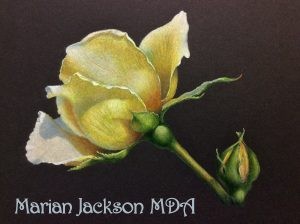
  • A student asked why I used violet to control the yellow.  Good question, so let’s explore the possibilities of controlling yellow.

    Choices:  We can use Black, White, an Earth color, a Neighbor, or the Complement.  There are other choices but these are the BASIC ones.

    • Black – won’t work, turns yellow green
    • White – works but the value is lighter so can’t be used for shadow or darker areas.
    • Earth Color,  darker, duller yellows, like Yellow Ochre, all the way up into the browns.  Would work but tends to produce rather dull colors. Depends on what you want your end result to be.
    • A neighbor on the color wheel:  On both sides of yellow we have Orange and Green. The green is out as it just makes Yellow Green, changing the color family, so that leaves the Orange, which again changed the color family but might be acceptable.  Dull, dark oranges would be a good second choice to control the color but is warm in temperature.
    • The Complement – Violet – is both darker and cooler making it a perfect choice as is has the opposite qualities of light, warm yellow.  However it must be controlled, mainly by using a very light application.  You don’t want a heavy coat of purple showing rather than the end result of a controlled yellow which is slightly on the cool side.

    Experiment with the methods above and don’t discount the warm greys – depending on the final result you desire. Doing is the best way to learn color control.

    yellowviolet

  • Hydrangeas in Crystal Still working on the tabletop but had to take a break.  My fingers never ache as I have a very light touch but my shoulder freezes.  :-)

    This was taken directly from a photograph and I can see I need to tweak the design a little bit here and there.  It was a lot of fun. I am pleased with the light values I was able to achieve on the dark paper.  This will be an advanced seminar – although technique is the same.  The definition is the speed at which it is taught and the amount of help. I prefer to walk around the class instead of showing petal by petal.

    I am trying to decide if I want to dissolve the tabletop or just persevere until it is the way I want it. Decisions, decisions.

  • Too much color on edge of petal

    Too much color on edge of petal

    OK, let’s analyze the problem.  Seems to be to much color, the purple, and too much of a value change.  It appears that a wee bit too much of the purple was added in the second layer.

    On these petals that are outside the center of interest, Beige was laid down over the entire petal to begin with, then Violet, then Sunburst Yellow.   The petal edge is presenting itself as purple which means that even with an overlay of Sunburst Yellow the color did not neutralize.

    If we add more color in layers over the top, trying to *fix* this,  we will have one petal edge that is more burnished than any of the others.  At this point, it might be wise to remove the purple area entirely, either with a kneaded eraser, or gently with an electric eraser and start again.

    The second layer should be applied really, really lightly and the end result should be a coolish, neutralized yellow and not purple.  I quite like some cool accents throughout a painting so often leave them if they show as ’slightly’ purple, but they should be interesting and not distracting.

    My Petal

    My Petal

    Not only is there a value problem here, the purple is too dark against the background but also a temperature problem as the Sunburst Yellow has warmed it up.  It needs to more closely match the cool grey background in both value and temperature so going over the final yellow with a  cool grey might be very attractive. Choose a cool grey that matches the value of the paper.  Do let us know how this goes and don’t hesitate if you have more questions.

    More later on why I chose to use complements for this project.

Calendar

September 2010
M T W T F S S
« Feb    
 12345
6789101112
13141516171819
20212223242526
27282930